HISTORY
OF SHIKHISM:
Sikhism is a
spiritual, social, and political system of beliefs which considers spiritual
life and secular life to be intertwined.
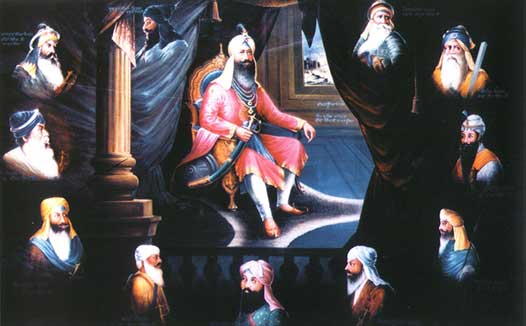
Guru Hargobind, the 6th Sikh
Guru, established the political/temporal (Miri) and spiritual (Piri) realms to
be mutually coexistent. According
to the 9th Sikh Guru, Tegh Bahadhur, the ideal Sikh should have both Shakti (power that resides in the temporal),
and Bhakti (spiritual meditative qualities). This
was developed into the concept of the baptized Saint Soldier of the Khalsa by the 10th Sikh Guru, Gobind Singh. Guru
Nanak described living an "active, creative, and practical life" of
"truthfulness, fidelity, self-control and purity" as being higher
than a purely contemplative life. According to Guru Nanak, the aim is to attain the
"attendant balance of seperation-fusion, self-other, action-inaction,
attachment-detachment, in the course of daily life, the polar opposite to a self-centered
existence. In Sikhism there is no dogma, priests, monastics or yogis.
The history
of Sikhism is closely
associated with the history of Punjab and the
socio-political situation in India.
Known to be a distinct
religion, Sikhism has no connection of any sort with either Hinduism or Islam.
The origin of the religion in India dates back to the birth of Guru Nanak Dev
Ji in 1469.
Founded by the great saint Guru Nanak Dev Ji,
Sikhism is the youngest religion of the world dating back barely to five
hundred years old. Its founder, Guru Nanak, was born in 1469. Guru Nanak spread
a simple message of "Ek Ong Kar": we are all one, created by the One
Creator of all Creation. This was at a time when India was being torn apart by
castes, sectarianism, religious factions, and fanaticism. He aligned with no
religion, and respected all religions. He expressed the reality that there is
one God and many paths, and the Name of God is Truth, "Sat Nam".
The followers
of this cult were called Sikhs who were taught to bow to none except the
almighty and their Gurus only who are believed to be basking in the glory of
direct consciousness of God. They are taken to be living in the direct light of
God and are not away form Him. Thus they are taken to be capable of leading
their followers from darkness to light.
A very distinct branch of Sikhism rather a cult
was further created by the tenth Sikh Guru, Sri Gobind Singh Ji in 1699. The
followers of this distinct religion have sustained themselves bravely even
after enduring a number of hardships in these 537 years, since its inception.
This school of thought has undergone various changes in the different eras of
its history that include Guru's Period Era, Banda Singh Bahadur Era, Religious
Persecution Era, Sikh Kingdom Era, Colonial Era, Sikh Immigrants and the
Present Era.
Generally Sikhism has had
amicable relations with other religions. However, during the Mughal rule of
India (1556–1707), the emerging religion had strained relation with the ruling Mughals. Prominent Sikh Gurus were martyred by Mughals for opposing some Mughal emperors'
persecution of Sikhs and Hindus.[3]Subsequently,
Sikhism militarized to oppose Mughal hegemony. The
emergence of the Sikh Confederacy under the misls and Sikh
Empire under reign of the
Maharajah Ranjit Singh was characterized by religious
tolerance and pluralism with Christians, Muslims and Hindus in
positions of power. The establishment of the Sikh
Empire is commonly considered the
zenith of Sikhism at political level, during
this time the Sikh Empire came to include Kashmir, Ladakh, and Peshawar. Hari Singh Nalwa, the
Commander-in-chief of the Sikh army along the North West Frontier, took the
boundary of the Sikh Empire to the very mouth of the Khyber Pass. The Empire's secular administration integrated
innovative military, economic and governmental reforms.
The months leading up to the partition of India in 1947, saw heavy conflict in the Punjab between Sikh and Muslims, which saw
the effective religious migration of Punjabi Sikhs and Hindus from West Punjab which mirrored a similar religious
migration of Punjabi Muslims in East
Punjab.
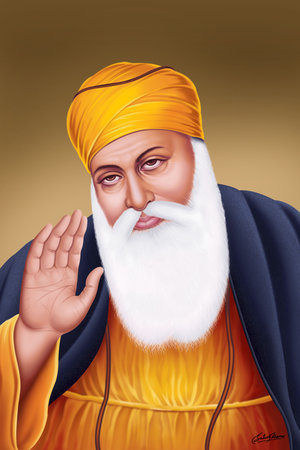
Guru
Nanak
Guru Nanak (1469–1538), founder of Sikhism, was
born to Kalu Mehta and Mata Tripta, in a Hindu family in the village of Talwandi, now called Nankana Sahib,
near Lahore. His father, a Hindunamed Mehta Kalu, was a Patwari,
an accountant of land revenue in the government.
Nanak's mother was Mata Tripta, and he had one older sister, Bibi Nanki.
From an early age Guru Nanak
seemed to have acquired a questioning and enquiring mind and refused as a child
to wear the ritualistic "sacred" thread called a Janeu and instead said that he would wear
the true name of God in his heart as protection, as the thread which could be
broken, be soiled, burnt or lost could not offer any security at all. From
early childhood, Bibi Nanki saw in her brother the Light of God but she did not
reveal this secret to anyone. She is known as the first disciple of Guru Nanak.
Even as a boy, Nanak was
fascinated by Hindu religion, and his desire to explore the mysteries of life
eventually led him to leave home. It was during this period that Nanak was said
to have met Kabir (1440–1518), a
saint revered by many. Nanak married Sulakhni, daughter of Moolchand Chona, a
trader from Batala, and they had
two sons, Sri Chand and Lakshmi
Das.
His brother-in-law, Jai Ram, the
husband of his sister Nanki, obtained a job for him in Sultanpur as the manager of the government
granary. One morning, when he was twenty-eight, Guru Nanak Dev went as usual
down to the river to bathe and meditate.
It was said that he was gone for three days. When he reappeared, it is said he
was "filled with the spirit of God". His first words after his
re-emergence were: "There is no Hindu, there is no Muslim". With this secular principle he began his missionary work. He made four distinct major journeys,
in the four different directions, which are called Udasis, spanning many thousands of
kilometres, preaching the message of God.
Guru Nanak spent the final years
of his life in Kartarpur where Langar free blessed food was available. The
food would be partaken of by Hindus, rich, poor, both high and so-called low
castes. Guru Nanak worked in the fields and earned his livelihood. After
appointing Bhai Lehna as the new Sikh Guru, on 22 September 1539, aged 70, Guru
Nanak met with his demise.He was the first & the most important GURU of the
SHIKHS.
Sikhs
retreat to Jungles:
In 1716 ca. Farrukh
Siyar, the Mughal Emperor, issued all Sikhs to be converted to Islam or die, an
attempt to destroy the power of the Sikhs and to exterminate the community as a
whole. A reward was offered for the
head of every Sikh. For a time it
appeared as if the boast of Farrukh Siyar to wipe out the name of Sikhs from
the land was going to be fulfilled. Hundreds of Sikhs were brought in from
their villages and executed, and thousands who had joined merely for the sake
of booty cut off their hair and went back to the Hindu fold again. Besides these there were some Sikhs
who had not yet received the baptism of Guru Gobind Singh, nor did they feel
encouraged to do so, as the adoption of the outward symbols meant courting
death.
After a few years Adbus Samad
Khan, the Governor of Lahore, Punjab and other Mughal officers began to pursuit Sikhs less and thus the
Sikhs came back to the villages and started going to the Gurdwaras again, which were managed by Udasis when the Sikhs were in hiding. The Sikhs celebratedDiwali and Vaisakhi at Harmandir
Sahib. The Khalsa had been split into two major fractions Bandia Khalsa
and Tat Khalsa and tensions were spewing between the two.
Under the authority of Mata
Sundari Bhai
Mani Singh become the Jathedar of the Harminder Sahib and a
leader of the Sikhs and the Bandia Khalsa and Tat Khalsa joined by Bhai Mani
Singh into the Tat Khalsa and
after the event from that day the Bandeis assumed a quieter role and
practically disappeared from the pages of history. A police post was
established at Amritsar to keep a check on the Sikhs.
Abdus Samad Khan, was transferred
to Multan in 1726, and his more energetic Son, Zakaria Khan, also known as Khan
Bahadur, was appointed to take
his place as the governor of Lahore. In 1726, Tarra Singh of Wan, a renowned Sikh leader, and his
26 men was killed after Governor Zakaria Khan, sent 2200 horses, 40 zamburaks, 5 elephants and 4 cannons, under
the command of his deputy, Momim Khan. The
murder of Tarra Singh spread across the Sikhs in Punjab and the Sikhs. Finding
no Sikhs around, the government falsely announced in each village with the beat
of a drum, that all Sikhs had been eliminated but the common people knew the
truth that this was not the case The
Sikhs did not face the army directly, because of their small numbers, but
adopted dhai phut guerrilla
warfare (hit and
run) tactics.
Under the leadership of Nawab
Kapoor Singh and Jathedar Darbara Singh, in attempt to weaken their enemy
looted many of the Mughals caravans and supplies and for some years no money
from revenue could reach the government treasury. When the forces of government tried to
punish the outlaws, they were unable to contact them, as the Sikhs did not live
in houses or forts, but ran away to their rendezvous in forests or other places
difficult to access.
Age of Revolution (1750 CE – 1914 CE)
Nawab
Kapur Singh :-- Nawab
Kapur Singh was born
in 1697 in a village near Sheikhupura, Punjab, Pakistan. He was
given a jagir in 1733 when the Governor of Punjab offered the Sikhs the Nawabship (ownership of an estate) and a
valuable royal robe, the Khalsa accepted it all in the name of Kapur Singh. Henceforth, he became known as Nawab
Kapur Singh. In 1748 he would organize the early Sikh
Mislsinto the Dal Khalsa (Budda Dal
and Tarna Dal).
Nawab Kapur Singh’s father was
Chaudhri Daleep Singh as a boy he memorized Gurbani Nitnem and was
taught the arts of war. Kapur
Singh was attracted to the Khalsa
Panth after the
execution of Bhai Tara Singh, of the village of Van, in 1726.
Extensive
Looting of the Mughal Government:
The Khalsa held a meeting to make plans to respond to the state repression
against the people of the region and they decided to take procession of
government money and weapons in order to weaken the administration, and to
equip themselves to face the everyday attacks. Kapur Singh was assigned to plan and
execute these projects.
Information was obtained that
money was being transported from Multan to the Lahore treasure; the Khalsa looted the money and took over the arms and
horses of the guards. They then
took over one lakh rupees from the Kasoor estate treasury going from Kasur to
Lahore. Next they captured a
caravan from Afghanistan region which resulted in capturing numerous arms and horses. The
Khalsa seized a number of vilayati (Superior Central Asian) horses from Murtaza
Khan was going to Delhi in the jungle of Kahna
Kachha. Some additional
war supplies were being taken from Afghanistan to Delhi and Kapur Singh
organized an attack to capture them. In another attack the Khalsa recovered
gold and silver which was intended to being carried from Peshawar to Delhi by
Jaffar Khan, a royal official.
Government
Sides with The Khalsa:
The Mughal rulers and the commanders
alongside the Delhi government lost all hope of defeating the Sikhs through
repression and decided to develop another strategy, Zakaria Khan, the Governor
of Lahore, went to Delhi where it was decided to
befriend the Sikhs and rule in cooperation with them and in 1733 the Dehli
rulers withdrew all orders against the Khalsa. The Sikhs were now permitted to own
land and to move freely without any state violence against them. To co-operate with the Khalsa Panth, and win the goodwill of
the people, the government sent an offer of an estate and Nawabship through a famous Lahore
Sikh, Subeg Singh. The Khalsa did
not wanted to rule freely and not to be under the rule of a subordinate
position. However this offer was eventually accepted and this title was
bestowed on Kapur Singh after it was sanctified by
the touch of Five Khalsas feet. Thus Kapur Singh became Nawab Kapur
Singh. Kapur Singh guided the Sikhs in strengthening themselves and preaching Gurmat to the people. He knew that
peace would be short lived. He encouraged people to freely visit their Gurdwaras and meet their relatives in
the villages.
DAL KHALSA
The Khalsa reorganized themselves into two divisions, the younger generation
would be part of the Taruna Dal, which provided the main fighting force, while
the Sikhs above the age of forty years would be a part of the Budha Dal, which
provided the responsibility of the management of Gurdwaras and Gurmat preaching. The Budha Dal would be responsible to
keep track of the movements of government forces, plan their defense
strategies, and they provide a reserve fighting force for the Taruna Dal
The following measures were
established by Nawab Kapur Singh:
·
All money obtained from anywhere by any Jatha should be deposited in the Common Khalsa Fund.
·
The Khalsa should have their common Langer for both the Dals.
·
Every Sikh should respect the orders of his Jathedar. Anyone
going anywhere would get permission from him and report to him on his return.
5 Sikh
Misls of the Dal Khalsa
The Taruna Dal quickly increased
to more than 12,000 recruits and it soon became difficult to manage the house
and feeding of such a large number of people at one place. It was then decided to have five
divisions of the Dal, each to draw rations from the central stocks and cook its
own langar. These
five divisions were stationed around the five sarovars (sacred pools) around Amritsar they were Ramsar, Bibeksar, Lachmansar, Kaulsar and Santokhsar. The divisions later became known as Misls and their number increased to eleven. Each took over and ruled a
different region of the Punjab.
Collectively they called themselves the Sarbat
Khalsa.
Preparing
Jassa Singh Ahluwalia for leadership:
Being the leader of the Khalsa Nawab
Kapur Singh was given
an additional responsibility by Mata
Sundari, the wife of Guru
Gobind Singh sent Kapur
Singh the young Jassa Singh Ahluwalia and told him that Ahluwalia was like a son to her and that the
Nawab should raise him like an ideal Sikh.
Ahluwalia under the guidance of Kapur Singh, was given a good education in Gurbani and a thorough training in managing the Sikh affairs. Later Jassa
Singh Ahluwalia would become an important role in leading the Sikhs to
self-rule.
State
Oppression
In 1735, the rulers of Lahore attacked and repossessed the jagir (estate) given to the Sikhs only two years before however Nawab
Kapur Singh in
reaction decided the whole Punjab should be taken over by the Sikhs. This decision was taken against heavy
odds but was endorsed by the Khalsa and all the Sikhs assured him of their full cooperation in his
endeavor for self-rule. Zakaria Khan sent roaming squads to hunt and kill the
Sikhs. Orders were issued to all administrators down to the village level
officials to seek Sikhs, murder them, get them arrested, or report their
whereabouts to the governments. One years wages were offered to anyone who
would murder a Sikh and deliver his head to the police station. Rewards were also promised to those
who helped arrest Sikhs. Persons providing food or shelter to Sikhs or helping
them in any way were severely punished.
This was the period when the
Sikhs were sawed into pieces, burnt
alive, their heads crushed with
hammers] and young children were pierced with spears before their mother’s
eyesTo keep their morale high, the Sikhs developed their own high-sounding
terminologies and slogans: For
example. Tree leaves boiled for food were called ‘green dish’; the parched chick peaswere
called ‘almonds’; the Babul tree was a ‘rose’; a blind man was a ‘brave
man’, getting on the back of a buffalo was ‘riding an elephant’.
The army pursued the Sikhs hiding
near the hills and forced them to cross the rivers and seek safety in the Malwa tract. When Kapur
Singh reached Patiala he met Maharaja Baba Ala Singhwho then took Amrit and Kapur Singh helped him increase the boundaries of his state.
In 1736 the Khalsa attacked Sirhind,
where the two younger sons of Guru
Gobind Singh were
martyred. The Khalsa took over the city, the took over the treasury and they
established the Gurdwaras at the historical places and withdrew, While near Amritsar the government of Lahore sent troops to attack the Sikhs. Kapur Singh entrusted the
treasury to Jassa Singh Ahluwalia, while having sufficient amount
of Sikhs with him to keep the army engaged. When Jassa Singh was reached a
consider distance the Khalsa safely retreated to Tarn
Taran Sahib. Kapur Singh sent messages to the Tauna Dal asking them to help
them in the fight. After a days of fighting Kapur Singh from the trenches dug
by the Khalsa surprisingly attacked the commanding posts killing three generals
alongside many Mughal officers. The Mughal army thus retreated to Lahore.
Zakaria Khan called his advisers
to plan another strategy to deal with the Sikhs. It was suggested that the
Sikhs should not be allowed to visit the Amrit Sarovar, which was believed to be the fountain
of their lives and source of their strength. Strong contingents were posted
around the city and all entries to Harmandir
Sahib were
checked. The Sikhs, however, risking their lives, continued to pay their
respects to the holy place and take a dip in the Sarovar (sacred pool) in the
dark of the night. When Kapur Singh went to Amritsar he had a fight with Qadi Abdul Rehman. He had declared that Sikhs the so-called lions, would
not dare to come to Amritsar and face him. In the ensuing fight Abdul Rehman
was killed. When his son tried to
save him, he too lost his life. In 1738 Bhai
Mani Singh was
executed.
Sikhs
attack Nader Shah:
In 1739 Nader
Shah of the Turkic Afsharid
dynasty invaded
and looted the treasury of the Indian subcontinent. Nader Shah killed more than
100,000 people in Delhi and carried off all of the gold and valuables. He added to his
caravan hundreds of elephants and horses, along with thousands of young women
and Indian artisans. When Kapur
Singh came to
know of this, he decided to warn Nader Shah that if not the local rulers, then
the Sikhs would protect the innocent women of Muslims and Hindus from being
sold as slaves. While crossing The river Chenab, the
Sikhs attacked the rear end of the caravan, freed many of the women, freed the
artisans, and recovered part of the treasure. The
Sikhs continued to harass him and lighten him of his loot until he withdrew
from the Punjab.
Sikhs
kill Massa Rangar
Massa Rangar, the Mughal Official, had token over the control of Amritsar. While
smoking and drinking in the Harmandir
Sahib, he watched the dances of nautch girls The Sikhs who
had moved to Bikaner, a desert
region, for safety, were outraged to hear of this desecration. In 1740 Sukha
Singh and Mehtab Singh, went to Amritsar disguised as revenue
collectors. They tied their
horses outside, walked straight into the Harmandir
Sahib, cut off his head, and
took it with them. It was a lesson for the ruler that no tyrant would go unpunished.
Sikhs
loot Abdus Samad Khan:
Abdus Samad Khan, a senior Mughal
royal commander, was sent from Delhi to subdue the Sikhs. Kapur
Singh learned of this scheme and planned his own strategy accordingly. As soon
as the army was sent out to hunt for the Sikhs, a Jatha of commandos disguised as messengers of Khan went to the armory. The
commander there was told that Abdus Samad Khan was holding the Sikhs under siege and wanted him with all his force to go and arrest them. The few
guards left behind were then overpowered by the Sikhs, and all the arms and
ammunition were looted and brought to the Sikh camp.
Mughals
increase persecution
Abdus Samad Khan sent many
roaming squads to search for and kill Sikhs. He was responsible for the torture
and murder of Bhai
Mani Singh, the head Granthi of Harimander Sahib. Samad Khan was afraid that Sikhs would kill
him so he remained far behind the fighting lines. Kapur Singh had a plan to get him.
During the battle Kapur Singh ordered his men to retreat drawing the fighting
army with them. He then wheeled around and fell upon the rear of the army. Samad Khan and his guards were lying
dead on the field within hours. The Punjab governor also was took extra
precautions for safety against the Sikhs. He started to live in the fort. He
would not even dare to visit the mosque outside the fort for prayers.
On the request of the Budha Dal
members, Kapur Singh visited Patiala. The sons
of Sardar Ala Singh, the founder and Maharajah of the Patiala
state, gave him a royal welcome. Kapur Singh subdued all local
administrators around Delhi who were not behaving well towards their people.
Zakaria Khan died in 1745. His
successor tightened the security around Amritsar. Kapur
Singh planned to break the siege of Amritsar. Jassa Singh Ahluwalia was made
the commander of the attacking Sikh forces. In 1748, the Sikhs attacked. Jassa
Singh Ahluwalia, with his commandos behind him, dashed to the army commander
and cut him into two with his sword. The commander's nephew was also killed.
The
Khalsa strengthen military developments:
The Sikhs built their first fort
Ram Rauni at Amritsar in 1748. In December 1748, Governor Mir Mannu had to
take his forces outside of Lahore to stop the advance of Ahmad
Shah Abdali. The Sikhs quickly overpowered the police defending the station in
Lahore and confiscated all of their weapons and released all the prisoners. Nawab Kapur Singh told the sheriff to inform the Governor that,
the sheriff of God, the True Emperor, came and did what he was commanded to do.
Before the policemen could report the matter to the authorities, or the army
could be called in, the Khalsa were already riding their horses back to the
forest. Nawab Kapur Singh died in
1753.
Chhota
Ghalughara (The Lesser Massacre)
In 1746 about seven thousand
Sikhs were killed and three thousand to fifteen thousand. Sikhs were taken prisoners during by
the order of the Mughal Empire when
Zakaria Khan, The Governor of Lahore, and
Lakhpat Rai, the Divan (Revenue Minister) of Zakaria Khan, sent military squads to kill
the Sikhs.
Jaspat Rai, a jagirdar (landlord) of the Eminabad area and also the brother of Lakhpat Rai, faced the Sikhs in a
battle one of the Sikhs held the tail of his elephant and got on his back from
behind and with a quick move, he chopped off his head. Seeing their master killed, the troops
fled. Lakhpat Rai, after this incident, committed himself to destroying the
Sikhs.
Through March–May 1746, a new
wave of violence was started against the Sikhs with all of the resources
available to the Mughal government, village officials were ordered to
co-operate in the expedition. Zakaria Khan issued the order that no one was to
give any help or shelter to Sikhs and warned that severe consequences would be
taken against anyone disobeying these orders. Local people were forcibly
employed to search for the Sikhs to be killed by the army. Lakhpat Rai ordered
Sikh places of worship to be destroyed and their holy books burnt. Information about including Jassa
Singh Ahluwalia and a large body of Sikhs were camping in riverbeds in the Gurdaspur district (Kahnuwan tract). Zakaria Khan managed to have 3,000 Sikhs of these Sikhs
captured and later got them beheaded in batches at Nakhas (site of the horse
market outside the Delhi gate). Sikhs
raised a memorial shrine known as the Shahidganj (the treasure house of
martyrs) at that place latter.
In 1747, Shah Nawaz took over as
Governor of Lahore. To please the Sikhs, Lakhpat Rai was put in prison by the
new Governor. Lakhpat Rai
received severe punishment and was eventually killed by the Sikhs.
Jassa Singh Ahluwalia
Jassa Singh Ahluwalia was born in 1718. His father, Badar Singh, died when Ahluwalia was only
four years old. His mother took
him to Mata Sundari, the wife of Guru Gobind Singh when Ahluwalia was young. Mata Sundri was impressed
by his melodious singing of hymns and kept the Ahluwalia near hear. Later Jassa
Singh Ahluwalia was adopted by Nawab Kapoor Singh then the leader of the Sikh
nation. Ahluwalia followed all Sikh qualities required for a leader Ahluwalia
would sing Asa di Var in the morning and it was
appreciated by all the Dal Khalsa and Ahluwalia kept busy doing seva (selfless service). He became very popular with the Sikhs. He used
to tie his turban in the Mughal fashion as he grew up in Delhi.
Ahluwalia learned horseback
riding and swordsmanship from expert teachers.
In 1748 Jassa Singh Ahluwalia
became the supreme commander of all the Misls Jassa
Singh Ahluwalia was honored with the title of Sultanul Kaum (King of the
Nation). Jassa Singh Ahluwalia was the head of the Ahluwalia Misl and then
after Nawab Kapoor Singh become the leader of all the Misls jointly called Dal
Khalsa. He played a major role In leading the Khalsa to self-rule in Punjab. In 1761
The Dal Khalsa under the leadership of Ahluwalia, would take over Lahore, the
capital of Punjab, for the
first time. The were the masters of Lahore for a few months and minted their
own Nanakshahi rupee coin in the name of 'Guru Nanak - Guru Gobind Singh'.
Chhota
Ghalughara (The Lesser Massacre)
In 1746 about seven thousand
Sikhs were killed and three thousand to fifteen thousand . Sikhs were taken prisoners during by
the order of theMughal Empire when
Zakaria Khan, The Governor of Lahore, and
Lakhpat Rai, the Divan (Revenue Minister) of Zakaria Khan, sent military squads to kill
the Sikhs.
Jaspat Rai, a jagirdar (landlord) of the Eminabad area and also the brother of Lakhpat Rai, faced the Sikhs in a
battle one of the Sikhs held the tail of his elephant and got on his back from
behind and with a quick move, he chopped off his head. Seeing their master killed, the troops
fled. Lakhpat Rai, after this incident, committed himself to destroying the
Sikhs.
Through March–May 1746, a new wave
of violence was started against the Sikhs with all of the resources available
to the Mughal government, village officials were ordered to co-operate in the
expedition. Zakaria Khan issued the order that no one was to give any help or
shelter to Sikhs and warned that severe consequences would be taken against
anyone disobeying these orders. Local people were forcibly employed to search
for the Sikhs to be killed by the army. Lakhpat Rai ordered Sikh places of
worship to be destroyed and their holy books burnt. Information about including Jassa
Singh Ahluwalia and a large body of Sikhs were camping in riverbeds in the Gurdaspur district (Kahnuwan tract). Zakaria Khan managed to have 3,000 Sikhs of these Sikhs
captured and later got them beheaded in batches at Nakhas (site of the horse
market outside the Delhi gate). Sikhs
raised a memorial shrine known as the Shahidganj (the treasure house of
martyrs) at that place latter.
In 1747, Shah Nawaz took over as
Governor of Lahore. To please the Sikhs, Lakhpat Rai was put in prison by the
new Governor. Lakhpat Rai
received severe punishment and was eventually killed by the Sikhs.
Reclaiming
Amritsar
In 1747 Salabat Khan, a newly
appointed Mughal commander, placed police around Amritsar and built observation
posts to spot and kill Sikhs coming to the Amrit Sarovar for a holy dip. Jassa Singh Ahluwalia and Nawab Kapoor
Singh lead the Sikhs to Amritsar and Salabat Khan was killed by Ahluwalia and
his nephew was killed by the arrow of Kapur Singh. The Sikhs restored Harmandir Sahib and
celebrated their Diwali gathering there.
Reorganization
of the Misls:
In 1748 all the Misls joined
themselves under one command and on the advice of the aging Jathedar Nawab Kapoor Singh Jassa Singh Ahluwalia was made the supreme
leader. They also decided to
declare that the Punjab belonged to them and they would be the sovereign rulers
of their state. The Sikhs also built their first fort, called Ram Rauni, at Amritsar.
Khalsa
side with the Government
Adina
Beg, the Faujdar (garrison commander) of Jalandhar, sent a message to the Dal Khalsa chief to
cooperate with him in the civil administration, and he wanted a meeting to
discuss the matter . This was seen as a trick to disarm the Sikhs and keep them under
government control. Jassa Singh Ahluwalia replied that their meeting place
would be the battle ground and the discussion would be carried out by their
swords. Beg attacked the Ram Rauni fort at Amritsar and besieged the Sikhs
there. Dewan Kaura Mal advised the Governor to lift the siege and prepare
the army to protect the state from the Durrani invader, Ahmed Shah Abdali.
Kaura Mal had a part of the revenue of Patti area given to the Sikhs for the
improvement and management of Harmandir Sahib, Amritsar.
Kaura Mal had to go to Multan to quell a rebellion there. He asked the Sikhs for help and they agreed
to join him. After the victory at Multan, Kaura came to pay his respects to the Darbar Sahib, and offered 11,000 rupees
and built Gurdwara Bal-Leela; He also spent
3,000,000 rupees to build a Sarover (holy water) at Nankana Sahib, the birthplace of Guru
Nanak Dev. In 1752, Kaura Mall was
killed in a battle with Ahmed Shah Abdali and state policy towards the Sikhs
quickly changed. Mir Mannu, the Governor, started hunting Sikhs again. He
arrested many men and women, put them in prison and tortured them. In November
1753 , when he went to kill the
Sikhs hiding in the fields, they showered him with a hail of bullets and Mannu
fell from the horse and the animal dragged him to death. The Sikhs immediately
proceeded to Lahore, attacked the prison, and got all the prisoners released
and led them to safety in the forests.